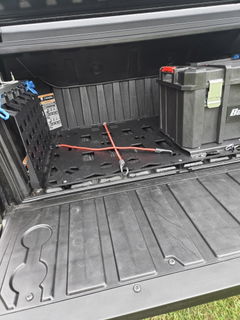
Stop messing with complex software design and get straight to building with our precision-fabricated, physical tool helper. This laser-cut Milwaukee Packout router template allows you to effortlessly rout custom wooden tops, workstation setups, or specialized flush-mount enclosure projects for your full-width modular toolboxes.
WHY YOU'LL LOVE IT
-
Ready Out of the Box: A physical, ruggedly built shop guide shipped directly to your door—completely eliminating the need for a CNC table, laser cutter, or programming files.
-
Built-In Bushing Offset: Precision engineered with a built-in .125" offset on the interior coordinates to perfectly guide your pattern bits or router guide bushings without error.
-
Heavy-Gauge Steel Build: Laser-cut from thick American steel to fully resist router bit friction and edge wear, outlasting dozens of flimsy DIY wood or plastic templates.
-
Flawless Tool Fitment: Guarantees a perfectly snug, factory-clearance lock down for your modular boxes every single time you plunge and cut.
| FEATURES & SPECIFICATIONS |
| Product Type |
Physical Tool Template (Shipped Hard Goods) |
| Material Thickness |
Heavy-duty steel substrate. |
| Edge Finish |
Precision laser-cut edges, fully deburred and finished smooth to protect router hardware bearings. |
| Compatibility |
Fits Full Width Milwaukee Packout toolboxes with complete dimensional accuracy. |
| Origin |
Proudly fabricated and hand-finished in Apple Valley, USA — BOCO Custom |
| Intended Use |
Designed specifically as a guide tool for manual wood routers, custom cabinet building, and workbench modifications. |
USAGE & PRODUCTION NOTES
- Clamp or firmly secure the steel template down onto your target wood, MDF, or plastic workpiece substrate.
- Equip your handheld router with a high-quality flush-trim pattern bit or guide bushing assembly.
- Run the router bearing guide along the interior paths of the steel plate to easily replicate the exact toolbox mounting geometry into your project wood.
⚠️ PLEASE NOTE: This is a physical steel ROUTER GUIDE TEMPLATE ONLY. It is NOT structured or finished to act as a permanent vehicle cargo mounting plate or tie-down bracket. Packout boxes are not included.
Frequently Asked Questions
Is this an online file download?
No. This is a physical piece of heavy-duty American steel tool hardware that is boxed and shipped directly to your shop. If you run your own laser/plasma table and want to cut your own guide plate, we sell the digital file variant separately in our DXF collection.
What is the purpose of the built-in offset?
Standard layout dimensions leave zero clearance for active router tooling. Our integrated .125-inch offset expansion ensures your routing bits track perfectly along the template line while generating a final product opening that sits snug with factory tool locks.
Are BOCO Custom products associated with Milwaukee Tool?
Listing Note: BOCO Custom LLC is an independent fabrication brand. We are not officially affiliated with or endorsed by any of the tool manufacturers pictured or mentioned across our platform store listings.
Superior Design for Accurate Routing
The Milwaukee Packout Router Template is engineered to deliver unmatched precision in every routing task. Designed to fit seamlessly with Milwaukee Packout storage systems, this template offers a secure and stable foundation for accurate cuts. Its rigid construction prevents flex and movement, ensuring crisp, clean edges every time. Whether you're shaping edges, creating inlays, or working on complex joinery, this router template provides the reliability needed for professional results.
Robust Build Quality for Long-Term Use
Constructed from high-quality materials, the Milwaukee Packout Router Template is built to endure heavy job site demands. Its durable design resists wear and tear, maintaining consistent accuracy over extended use. This template withstands the rigors of repeated setups and transportation within the Packout system, making it a valuable addition for professionals who require dependable tools from project to project.
Easy Integration and Versatile Compatibility
One of the standout features of the Milwaukee Packout Router Template is its effortless integration with existing Milwaukee Packout components. The template fits securely within the system, simplifying storage and transport while preventing loss or damage. Additionally, its compatibility with a wide range of routers allows users to switch between tools without hassle. This versatility maximizes efficiency and makes it an essential tool for craftsmen seeking convenience and performance.
10-Gauge Steel (0.1345" | Thickness of Two Stacked Dimes)
- Best For: Heavy-duty commercial wall mounts, shop workbenches, and massive modular tool stacks.
- The Advantage: Extreme structural stiffness. This ultra-thick steel completely eliminates flexing, twisting, and tool rattling, making it the definitive choice for demanding daily job-site use.
12-Gauge Steel (0.1046" | Thickness of a Standard House Key)
- Best For: Mobile service vans, enclosed trailers, and standard shop organization layouts.
- The Advantage: The ultimate sweet spot between bulletproof strength and smart weight distribution. It handles constant over-the-road vibrations flawlessly without adding unnecessary bulk to your mobile rig.
14-Gauge Steel (0.0747" | Thickness of a Nickel)
- Best For: Handheld battery organizers, small tool holsters, and lightweight shelf accessories.
- The Advantage: High-tensile rigidity in a streamlined profile. It provides a rock-solid, permanent mount for smaller gear while keeping your workspace layout clean and low-profile.
8-Gauge Aluminum (0.1285" | Heavy-Duty Marine Grade)
- Best For: Open truck beds, roof racks, exterior trailer sides, and high-moisture environments.
- The Advantage: Maximum corrosion resistance with severe weight savings. Shaved pounds keep your mobile fuel efficiency optimized while remaining completely immune to rain, snow, and road salt oxidation.
10-Gauge Stainless Steel (0.1345" | Thickness of Two Stacked Dimes)
- Best For: Premium exposed truck bed brackets, marine applications, high-end shop builds, and ultimate weather protection.
- The Advantage: Combines the absolute, unyielding structural rigidity of our thickest 10-gauge plate with total lifetime corrosion resistance. It requires no paint or powder coat to stay 100% immune to rust, road salt, and harsh outdoor elements.
Note: Sheet metal gauge numbers run inversely—the lower the gauge number, the thicker and more rigid the actual metal substrate is.
What is Proposition 65?
Proposition 65 (officially known as the Safe Drinking Water and Toxic Enforcement Act of 1986) is a California law that requires businesses to provide a warning to California consumers if their products contain chemicals known to the State of California to cause cancer, birth defects, or other reproductive harm.
These warnings are required even if the chemical is present in incredibly low amounts that may not pose any significant risk to your health.
California Proposition 65 Warning
⚠️ WARNING: Products sold on this website can expose you to chemicals including lead, nickel, chromium, or other phthalates, which are known to the State of California to cause cancer and birth defects or other reproductive harm. For more information, go to www.P65Warnings.ca.gov.
Why is this warning on my order?
Because BOCO Custom LLC ships products nationwide, we include this warning to ensure full compliance with California law. A Proposition 65 warning does not mean a product is unsafe or defective; it simply means the product contains a trace amount of a regulated substance. We prioritize the safety of our customers and provide this information so you can make informed purchasing decisions.